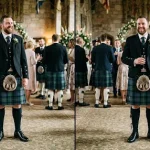
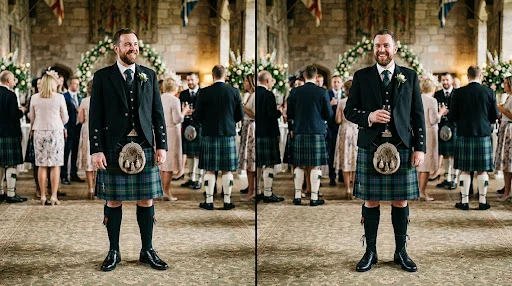
I’ve spent years watching first-time kilt wearers make the same mistake at weddings, formal events, and Highland gatherings — and almost always, it’s the same one.
They get the kilt right. They get the jacket right. They might even nail the sporran, the belt, and the kilt pin. And then they look down at their feet and decide that any decent pair of black dress shoes will work.
It won’t. And the moment they walk into the room, every Scot in attendance knows.
The traditional kilt has very specific footwear that completes it. That footwear is not optional. It is not interchangeable with regular dress shoes. It’s called the ghillie brogue shoe, and once you understand what it does and why it exists, you’ll never make the substitution again.
What Makes a Ghillie Brogue Shoe Different
To understand why this footwear is non-negotiable with a traditional kilt, you have to understand what makes a ghillie brogue different from any other shoe in your closet.
The defining design features:
No tongue
Where every other dress shoe has a tongue under the laces, ghillie brogues have an open lacing area. The top of the foot is exposed where the laces cross.
Long laces that wrap around the ankle
Standard dress shoes have short laces that tie at the top of the shoe. Ghillie brogues have long leather laces — sometimes 30 inches or more — that thread up the front, wrap around the ankle, and tie below the calf with the ends tucked behind.
Punched leather pattern (broguing)
The decorative pattern of small punched holes across the toe, sides, and heel of the shoe. This is where the word “brogue” comes from.
Thin, flat sole
Ghillie brogues sit low to the ground. There’s no chunky sole, no athletic profile, no hidden lift. The thin sole keeps the visual line clean from the kilt down.
Black polished leather
For formal wear. Some less formal occasions allow brown, but black is the standard.
These design choices aren’t arbitrary aesthetic decisions. Each one has a historical reason — and that history is what gives the shoe its visual authority on a kilt outfit.
The Highland Origin Story
The original ghillie brogue (or “ghillie” — pronounced “gilly”) was designed for crossing wet Highland terrain.
The open lacing system existed because traditional Highlanders frequently walked through rivers, streams, and bogs. A shoe with a closed tongue trapped water inside, where it would slosh around and never dry. An open-laced shoe with no tongue let water flow through and out, allowing the foot to dry as the wearer continued moving.
The long laces wrapping around the calf served a similar function — they kept the shoes secured during extended walking on rough ground, so the wearer wouldn’t lose them in mud, water, or thick heather.
The thin sole was practical for stalking deer (the original meaning of “ghillie” relates to deerstalking attendants). A thin sole let the wearer feel the ground, move quietly, and stay low.
When formal kilted dress evolved during the Victorian-era Highland revival, the shoe came along with it — but with the practicality preserved. Modern formal ghillie brogues are polished and refined, but the design language is unchanged.
What Happens When You Wear Regular Dress Shoes Instead
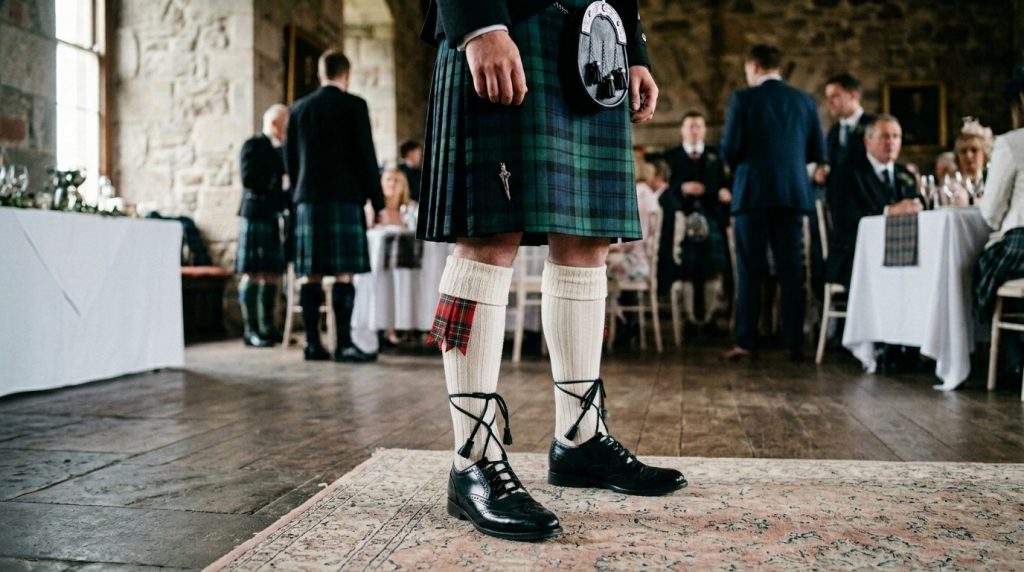
Watch any wedding photographer’s portfolio of Scottish weddings and you’ll see the difference clearly.
The men in proper ghillie brogue shoes have a clean visual line from kilt hem down to floor. The thin sole, the wrap-around laces, and the broguing pattern all work together to anchor the kilt look.
The men in regular Oxford or Derby dress shoes look subtly off. The chunkier sole creates a visual break. The short laces stop at the shoe top, leaving the kilt hose looking exposed and disconnected from the foot. The closed tongue interrupts the leg line.
It’s the kind of thing you can’t unsee once you see it. And in person, at a real event, the difference is even more obvious than in photos.
I’ve stood at the back of more than one wedding watching the groomsmen file in and immediately seen which ones rented their full kilt outfit (correctly) and which ones rented just the kilt and tried to use their own dress shoes. The shoe choice tells the entire story.
The Visual Proportions Argument
Here’s the technical reason the substitution doesn’t work, beyond just authenticity.
A traditional kilt sits at the natural waist (above the navel) and falls to mid-knee. The kilt hose start about two fingers below the kneecap and end at the ankle. There’s a deliberate visual proportion at play — three roughly equal sections from waist to floor: kilt apron, knee gap, hose-and-shoe.
The shoe is the bottom anchor of this proportion system. A ghillie brogue, with its thin sole and wrapping laces, blends seamlessly into the kilt hose section. The leg becomes one continuous, elegant column from knee to floor.
A regular dress shoe — with its chunkier sole, raised heel, and visually distinct shape — breaks that column. The leg looks shorter. The proportions look off. The traditional kilt’s silhouette, which depends on long, clean lines, gets disrupted at the most visible point.
This is why the substitution looks wrong even to people who don’t know the technical reason. The eye registers it before the brain does.
The Cultural Weight Argument
There’s another layer to this beyond proportions and design.
A traditional kilt is not just clothing. It’s an act of cultural participation. Wearing one — even at a friend’s wedding, even as someone with no Scottish ancestry — is a small but real engagement with Scottish heritage.
Engaging with that heritage carries an implicit responsibility to do it correctly. The same way that wearing a tuxedo halfway (with the wrong shoes, no bow tie, sneakers underneath) reads as disrespectful to formal dress traditions, wearing a traditional kilt with regular dress shoes reads as half-hearted to anyone familiar with Highland dress.
It’s not about being judged. It’s about taking the cultural form seriously enough to honor it. If you’re going to put on a kilt, the message you want to send is “I respect this enough to wear it correctly.”
When You Can Actually Skip the Ghillie Brogues
Some legitimate exceptions exist:
- Modern utility kilts and casual kilts — These aren’t traditional Highland dress, so the traditional shoe rules don’t apply. Boots, sneakers, or alternative footwear can work with these styles.
- Athletic events — A sport kilt at a 5K race calls for running shoes, obviously. Traditional footwear rules don’t apply to athletic kilts.
- Highland Games competitions — Some events allow practical athletic footwear during competition while requiring traditional dress before and after.
- Themed costume events where you’ve intentionally subverted tradition — A modern reinterpretation of kilt wear can absolutely use non-traditional footwear by design.
For everything else — weddings, ceremonies, Burns Night, formal events, traditional cultural occasions — ghillie brogues are the only correct answer.
Buying Your First Pair
A few practical points for the first purchase:
Sizing
Ghillie brogues fit similar to standard dress shoes but slightly more snug. The lack of tongue means there’s no padding to absorb extra room. Order true to size. If between sizes, go up half.
Leather quality
Polished black calfskin is the standard for formal wear. Cheaper synthetic leather looks plastic in photographs and doesn’t break in. Spend the extra $40 to $80 for genuine leather. Your first pair should last a decade or more.
Lace length
Longer is better. The wrap-around-and-tie technique requires significantly more lace than standard shoes. Some pairs come with multiple lace lengths to accommodate different calf sizes.
Sole
Leather soles are most traditional but slick on wood floors. Rubber-soled ghillie brogues exist and are perfectly acceptable for modern wear. Choose based on your event environments.
Price range
$80 to $150 for a quality entry-level pair. $150 to $250 for premium leather construction. Above $250 for handmade, named-maker pairs that become lifetime pieces.
A good pair of ghillie brogues should outlast your first three kilts. Buy once, buy well.
How to Tie Ghillie Brogues Properly
The tying technique is unique enough that it deserves its own walkthrough.
- Lace the shoes normally up to the top eyelets, keeping equal length on both sides
- Cross the laces over the top of the foot and bring them up the leg
- Wrap each lace once or twice around the back of the calf, just above the ankle
- Bring both laces back to the front
- Tie a simple bow at the front of the calf, about 4 inches below the kneecap
- Tuck the bow’s free ends behind the wrap so they don’t dangle
The position of the bow matters. Too low and it disappears beneath the hose cuff. Too high and it interferes with the kilt hem. The 4-inch-below-kneecap target is the same height as where your kilt hose flashes peek out.
If you’re new to this, practice tying them at home before the event. The first time takes 5 minutes per shoe; by the third time, you’ll be down to under 60 seconds.
Pairing With the Rest of Your Traditional Kilt Outfit
A complete traditional kilt ensemble with proper ghillie brogues includes:
- Tartan wool kilt at the natural waist
- Cream or off-white kilt hose folded below the knee
- Garter flashes peeking from the hose cuff
- Black or brown leather sporran with chrome or silver fittings
- Wide leather kilt belt with polished buckle
- White wing-collar or banded-collar shirt
- Bow tie or four-in-hand tie
- Argyll, Prince Charlie, or tweed jacket
- Black ghillie brogues, properly laced
- Optional sgian dubh in the right kilt hose
The whole system reads as a single coordinated outfit, with the ghillie brogues anchoring the bottom in a way that makes everything above them look intentional.
Frequently Asked Questions
Can I wear brown ghillie brogues with a black kilt outfit?
For formal events, no — black is standard. For tweed-jacket country wear or daytime semi-formal events, brown is acceptable.
Are ghillie brogues comfortable for all-day wear?
Once broken in, yes. New pairs can be stiff for the first 4 to 6 wears. Wear them around the house with your kilt hose to break them in before a major event.
Can women wear ghillie brogues?
Yes. There are women’s-specific ghillie brogues and women’s-cut ghillie shoes (a related, slightly more delicate version). Both work with kilted skirts and women’s Highland dress.
What’s the difference between ghillie brogues and ghillie shoes?
Ghillie brogues have the punched-leather broguing pattern. Ghillie shoes have the same open-laced wrap-around construction but plain leather without the broguing. Ghillie shoes are often considered more modern; ghillie brogues are more traditionally formal.
Can I wear ghillie brogues without a kilt?
You can, but the design is so specifically associated with kilt outfits that they look out of place with trousers. They read as “dress shoes from a costume” rather than versatile footwear.
Do I need to polish ghillie brogues like dress shoes?
Yes. Standard leather shoe polish, applied every few wears, keeps them looking sharp. The broguing pattern catches dust, so a soft brush before polishing helps.
The traditional kilt isn’t just a piece of clothing — it’s a complete system, with each piece earning its place over centuries of refinement. The ghillie brogue is the bottom anchor of that system. Skip it and the system stops working. Wear it correctly and the entire outfit speaks for itself.