AI Essay generators have become especially popular, showing up everywhere—from student forums and writing apps to classroom discussions and academic policies. Some people see them as shortcuts, while others treat them as helpful learning tools.
This article breaks down everything about essay generators—what they are, how they work, what they’re good at, where they fall short, and how to use them responsibly in real writing.
What Is an AI Essay Generator, Exactly?
At its simplest, an AI essay generator is a software tool that produces written text—often in essay form—based on a prompt you provide.
That prompt might be a question (“What caused the Great Depression?”), a topic (“social media and mental health”), or a set of instructions (“write a five-paragraph argumentative essay with a neutral tone”).
It’s important to separate essay generators from other writing-related tools:
- Not just spellcheck: Grammar checkers fix mistakes in text you already wrote. Essay generators create new text from scratch.
- Not a search engine: They don’t look up answers in real time or cite sources automatically.
- Not old-school templates: Unlike fill-in-the-blank essay formats, modern generators adapt their output based on context and phrasing.
In practice, people use AI essay generators for many reasons: brainstorming ideas, getting unstuck on a blank page, testing structure, or drafting something they plan to revise heavily. They’re tools for drafting, not instant finished products.
The Core Technology Behind AI Essay Generators
Most modern essay generators are built on what are called large language models, often shortened to LLMs.
A language model is a system trained on enormous amounts of text—books, articles, websites, and other publicly available writing. During training, the model learns patterns in language: which words tend to follow others, how sentences are structured, and how ideas typically flow in different types of writing.
A key point that’s often misunderstood: These models don’t “know” facts the way humans do. They generate text by predicting what words are most likely to come next, based on patterns they’ve seen before.
If that sounds abstract, think of it like advanced autocomplete. Your phone suggests the next word in a text message. An essay generator does the same thing, just at a much larger and more sophisticated scale.
This pattern-based approach is also what makes AI-generated essays easier for AI detectors to analyze.
Step-by-Step: How an AI Essay Generator Produces Text
To make this concrete, let’s break down what happens when you use an AI essay generator.
1. Input: Defining Your Hints
Most modern AI writers are web-based tools, which means you can usually access them on a laptop or a mobile phone.
When you open the tool, you’ll typically see a generation settings interface. This is where you define the key parameters that guide the writing process. Common inputs include:
- Your topic or research question
- Target length (for example, 1,000–1,200 words)
- Tone (formal, analytical, or conversational)
- Article type (argumentative, expository, or literary overview)
- Structure guidelines (introduction, body paragraphs, conclusion)
- Optional keywords or specific focus areas
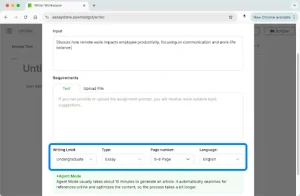
The quality of your input matters a lot. Clearer and more specific hints usually lead to a draft that is more focused, relevant, and practical.
2. Generating the Outline and Overall Direction
After you submit your inputs, the model analyzes them and begins predicting text based on patterns it has learned from similar types of writing.
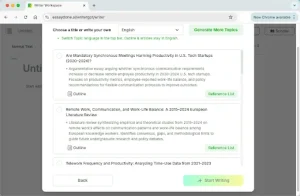
In many tools, this stage involves generating an outline or a structured plan before writing the full article. This gives you a chance to review the academic logic of the structure. At this point, you can decide whether certain sections need to be expanded, removed, or clarified before moving on to the next step.
3. Output: Producing a Draft Article
Once the structure is finalized, the generator produces a complete draft that resembles a standard academic article or paper. The paragraphs are logically organized, topic sentences are clear, and transitions between sections are generally smooth and natural.
More advanced writing tools may also provide additional editing options, such as:
- Refining arguments to better align with course materials
- Adding credible sources and citations
- Adjusting formatting
- Reworking wording to better match your personal writing style
- Correcting grammatical or language errors
These features are designed to support revision, not replace your judgment, allowing you to improve the draft step by step.
This is also the point where you can rewrite AI text, sometimes manually and sometimes with the help of an AI humanizer, to adjust tone, rhythm, and wording so the essay feels more natural and more clearly human.
Pros and Cons of Essay Generators
Where Essay Generators Get It Right
When used for the right purposes, essay generators can be genuinely helpful tools rather than shortcuts.
They tend to perform well in several key areas:
- Speed: You can generate a rough draft within seconds, which is especially useful when you’re short on time.
- Structure: The tool can organize ideas into a familiar essay format, including an introduction, body paragraphs, and a conclusion.
- Clarity: It can help untangle scattered thoughts and rewrite them into clearer, more readable sentences.
- Momentum: By giving you something on the page, it helps you move past writer’s block and start thinking critically about the topic.
Imagine you’re staring at a blank screen the night before an outline is due. An essay generator can quickly provide a starting point—something you can react to, revise, and improve. In that moment, having a rough draft is often far more productive than having nothing at all.
Where Essay Generators Can Go Wrong
The same features that make essay generators useful also introduce clear limitations.
Common problems include:
- Inaccurate information: The model may present statements that sound convincing but are factually incorrect.
- Generic language: On common topics, the writing can feel repetitive, vague, or overly general.
- Lack of depth: While AI is good at summarizing, it struggles with original insight, critical thinking, or personal perspective.
- Overconfidence: Because the writing often sounds polished, mistakes are easier to overlook.
Consider a real scenario: you use an AI-generated essay for a history assignment and submit it without checking the sources. The writing flows well, but one key date is wrong. That single error can undermine the credibility of the entire paper, even if everything else sounds reasonable.
So How Can You Address These Limitations?
The answer isn’t to stop using essay AI generators altogether—it’s to use them the right way.
The most important point is this: you remain the author. An essay generator can support the writing process, but it doesn’t replace your responsibility, judgment, or critical thinking.
Whether you’re using a tool to brainstorm ideas, organize structure, or smooth out wording, the human role is still essential. AI can help with organization and phrasing, but it cannot judge whether an argument is accurate, appropriate, or academically sound in the way you can.
For example, because essay generators don’t truly understand meaning, context, or truth, human review isn’t optional—it’s essential. You still need to step in and actively evaluate the draft.
That means taking responsibility for tasks such as:
- Verifying facts, data, and dates
- Adjusting the tone to match your instructor’s expectations or your intended audience
- Adding nuance, concrete examples, or personal insight
- Making sure the work meets ethical and academic standards
A useful way to think about AI-generated text is this: it’s like a rough draft written by a very fast, very confident intern. It can save time and provide structure, but it isn’t ready to submit or publish without careful review and revision.
When you treat AI as a tool—not a replacement—you can take advantage of its strengths while avoiding its most common pitfalls.
Understanding the Tool Makes You a Better Writer
Understanding how AI essay generators work can genuinely make your writing better. These tools aren’t magic, and they’re not something to fear—they’re just tools that work by spotting patterns in language.
When you know what they can and can’t do, you’re in control. You can use them to draft faster, revise smarter, and avoid unpleasant surprises. In the end, good writing still comes from you.